
Choosing the right water pump and water tank can save you more than half of your expenses.
- Kong
- 15 ต.ค. 2568
- ยาว 5 นาที
อัปเดตเมื่อ 31 ต.ค. 2568

Choosing the right water pump and water tank
1. When selecting the right water pump and tank, many users or homeowners may be confused about the size of the pump. However, there are some rough guidelines for selecting a water pump. For example, a single-story house should use a 150W pump, a two-story house 250W, and a three- to four-story house 400W. The data provided by each manufacturer is based on the estimated water usage rates of each building type and the distance traveled. Currently, most markets rely on motor capacity or wattage, but motor size does not necessarily reflect water flow efficiency as commonly understood. Therefore, users or homeowners should first calculate the appropriate water pump size for their needs, rather than relying solely on motor size or wattage. The following are guidelines: 1. Consider the number of water points and the total amount of water required in the home, in liters per minute. Furthermore, consider other appliances, such as showerheads, garden faucets, and other equipment, to obtain a rough estimate.
2. The number of residents to determine the water consumption. This will help you choose the right water pump for your needs.
3. Measure the distance and height of the water delivery, so you can compare it with the water delivery rate specifications of the pump when selecting one.
Let's look at an example of selecting a water pump.
If we have a two-story house, the approximate height of the water supply points is approximately 7 meters, and there are six faucets in the house, and we estimate that three of them will be used simultaneously, we would get the following:
1. Pump delivery distance: In this case, the height to the point where water is to be delivered is approximately 7 meters. We should allow for friction, such as using reducers, elbows, or other fittings, which will reduce delivery capacity. Therefore, we should allow a 30% allowance. Therefore, we should choose a pump with a delivery distance of at least 9 meters.
2. Water delivery capacity (liters/minute): We should consider the simultaneous water usage of the entire house. In this case, we have the potential to use water simultaneously at three points. Normally, faucets have a delivery rate of approximately 9 liters/minute. (The calculations here are approximate only, as the equipment used varies. For accurate results, you can check the water usage of each device on the label attached to the device.) Therefore, the estimated minimum water consumption for this house is 27 liters/minute.
Automatic water pump, Inverter system, energy saving
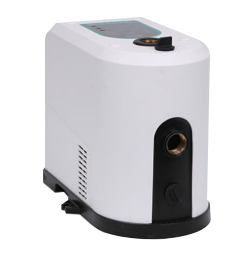
Automatic water pump Inverter system saves energy. The motor speed will rotate according to the amount of water used. To make it easier to visualize, when we turn down the faucet or turn on the water gently, the motor will also rotate slowly (use low rotation speed). As soon as the faucet is turned on, the motor will work at full power. The size of the automatic water pump ranges from 100-400 watts. For 100-150 watts, it is suitable for a house with 2-3 people. However, if it is a large detached house, a 450 watt inverter pump may be used. The system will be controlled by an electrical system. There is an electronic system to calculate water usage, such as a 450 watt pump. If we turn on water in only one spot, it will consume only 120 watts. Turn on water in 4 spots at the same time, it will consume 450 watts. Compared to a general 450 watt pump, turning on water in one spot immediately consumes 450 watts. Therefore, the inverter system helps us save on electricity costs. There are 2 types of automatic pumps: Type 1: Pump with air pressure tank Type 2: Constant pressure pump. For pumps with air pressure tanks, the advantage is that they last longer. But the disadvantage is that they may need to be refilled with air. Or when there is rust inside, we may have to replace the entire tank (the price is not high). As for the constant pressure pump, the advantage is that if we turn on the water at 4 points at the same time, the water pressure will flow equally at all 4 points, regardless of whether the faucet is at the front or the back. If comparing both types with the same wattage, the air pressure pump will supply water more forcefully.
What about water tanks? How necessary are they?
Once we've selected the water pump we want, do we need to purchase an additional water tank? What size tank should we choose? What material should we use?
Let's consider the following:
1. The ability to store tap water for home use in the event of a water outage or emergency, such as shutting off water for water mains (the waterworks main) or repairs, a broken water pipe accident that prevents water from being delivered, or even a power outage that prevents the water pump from functioning. We can still have water from the tank for emergency use.
2. It helps to hold water and allow for sedimentation of foreign matter that might have escaped with the water (foreign matter may have escaped during pipe connections or repairs before the water reaches the home).
3. It helps save on electricity costs, as once the tank is full, the pump doesn't need to be turned on, preventing the pump from running constantly.
What types of water tanks are there?
We basically divide water tanks into two types: above-ground and underground.
• Above-ground tanks are suitable for homes with sufficient space. Popular types of water storage tanks for this installation are stainless steel and plastic tanks installed above ground. Their advantages include easy maintenance and easy movement.
• Underground tanks are suitable for homes with limited space and require a strong support structure to prevent potential subsidence. Concrete and plastic tanks are suitable for this installation. What size tank do I need?
On average, one person uses approximately 200 liters of water per day. This means that the water tank should be calculated by multiplying the number of household members by their daily water consumption (the result should be multiplied by 2 to account for water shortages for more than one day).
*** 200 liters (water volume/person/day) x number of people in the house x number of days of water reserve.

"The selection of the appropriate water pump and water tank and the basics of water usage calculations mentioned above can be applied immediately to those looking for or installing a new water pump and water tank."
For more information
Tel. 02-292-1067-70
Youtube : Leopump ประเทศไทย
Line Official : @775ruust
Facebook : LEOpumpThailand
TikTok : Leopumpthailand
ตัวแทนจำหน่าย : https://www.leo.co.th/dealer


ความคิดเห็น